

close
Choose Your Site
Global
Social Media
Views: 0 Author: Site Editor Publish Time: 2026-07-06 Origin: Site


Most scrap metal balers pay for themselves in 12 to 36 months. Your payback time depends on your monthly scrap volume, the type of baler you choose, and current market prices. For example, if you process 300 tons of scrap each month and earn $50 more per ton, you could see a payback in about 20 months with a $300,000 baler.
Monthly Scrap Volume | Revenue Increase per Ton | Monthly Revenue Gain | Annual Gain | Baler Cost | Payback Time |
|---|---|---|---|---|---|
300 tons | $50 | $15,000 | $180,000 | $300,000 | ~20 months |
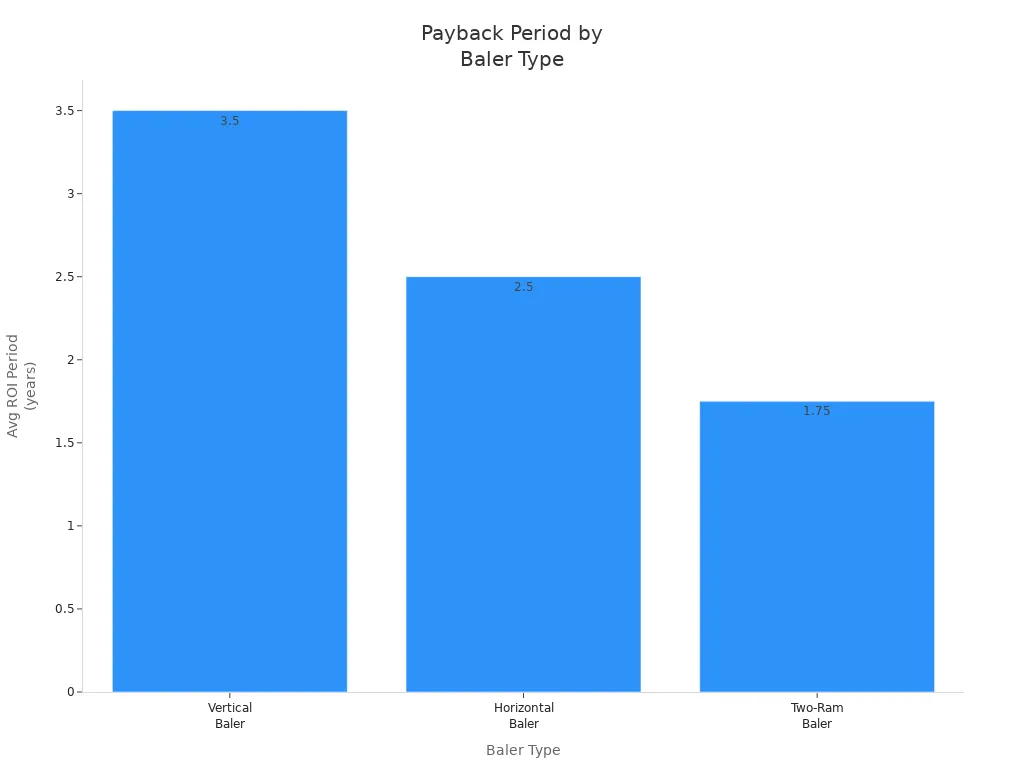
You can shorten or extend your payback period by choosing the right equipment for your operation.
Most scrap metal balers pay for themselves in 1 to 3 years. This depends on how much scrap you have and the market prices.
Picking the right baler type can change how fast you get your money back. Think about your business size and how you handle scrap.
Using a baler can lower labor costs and make work faster. You can process more scrap with fewer workers.
Keeping your baler in good shape helps it work well. This lowers long-term costs and helps you get more money back.
Use a simple formula to figure out your payback period. This helps you see if buying a baler is a good choice for your business.
You should think about how much a scrap metal baler costs at first. The price changes based on the type and size you pick. Here is a quick look:
Type of Baler | |
|---|---|
Vertical Balers | $15,000 – $40,000 |
Semi-Automatic Horizontal Balers | $50,000 – $150,000 |
Full-Auto Dual-Cylinder Systems | $200,000 – $500,000+ |
Many companies, like Huanhong Hydraulic, let you pay over time or lease. These choices can help you handle your money better, especially if your business is new. But, paying interest and other fees makes your total cost higher. This means it might take longer for your scrap metal baler to pay for itself.
How much scrap you handle each month matters a lot for payback time. If you process more scrap, you can make more money and save more. Good balers, like ones from Huanhong Hydraulic, let you work faster and handle more scrap. This helps you get your money back sooner.
A scrap metal baler means you need fewer workers. You can move scrap in and out faster, so you spend less on labor. Here is how your costs change after you get a baler:
Factor | Impact on Operational Costs |
|---|---|
Transportation Costs | Reduced by up to 20% due to more efficient loading. |
Labor Costs | Decreased due to faster loading/unloading. |
Efficiency | Increased throughput with the same workforce. |
It usually costs $10 to $20 per ton to run a baler for ferrous scrap. If you process more scrap, your cost per ton can go below $10.
Baling makes your scrap better. Clean and even bales are easier to sort and recycle. This means you can sell your scrap for more money. You also get better sorting and cleaner bales, which recycling plants like. With a scrap metal baler, you can sell more scrap for a higher price and use fewer workers.
You need to keep paying for things to make sure your baler works well. These costs include:
Cost Component | Description | Price Range |
|---|---|---|
Maintenance | Annual upkeep to prevent malfunctions | Varies by baler size/age |
Strapping Material | Ties for bales (polyester or wire) | $0.02 – $0.11 per meter |
Staffing | Labor to operate and monitor the baler | N/A |
Energy Consumption | Power needed, depends on usage and energy prices | N/A |
Huanhong Hydraulic balers last a long time and use less energy, so you can keep these costs down.
Tip: Picking the right baler for how much scrap you have and how big your business is can help you save more money and get your payback faster.
You can find out how long it takes for your baler to pay for itself with a simple formula. This formula shows if buying a baler is a good idea for your business. Here is how you do it:
Step | Description |
|---|---|
1 | Figure out your disposal cost. Multiply the weight of your scrap each week by the disposal cost per ton. Add any collection fees. |
2 | Find your possible bale revenue. Multiply the weight of your scrap each week by the bale price per ton for your material. |
3 | Get your gross financial benefit. Take your disposal cost away from your possible bale revenue before equipment and operating costs. |
4 | Divide your equipment investment by your gross annual benefit. This gives you the payback period in years. |
5 | If your payback period is less than three years, your investment is strong. |
You should use your own numbers for each step. This helps you see what your return will be.
Follow these steps to estimate your payback period:
Write down your key variables.
Use this table to organize your data:
Key Variable | Description |
|---|---|
Transportation Savings | Find your cost per mile and how many trips you save each year. |
Material Value Increase | Check the price difference between loose and baled scrap. This is often $20–$60 more per ton. |
Labor Efficiency | Estimate savings from moving workers because of baler automation. |
Add up your current costs.
Include disposal, labor, and transportation costs for handling scrap without a baler.
Estimate your new revenue and savings.
Figure out how much more you earn from selling baled scrap. Add your labor and transportation savings.
Take away your new operating costs.
Include energy, maintenance, and strapping material for your baler.
Find your gross annual benefit.
Add your increased revenue and cost savings. Then subtract your new operating costs.
Calculate your payback period.
Use this formula:
Payback Period (years) = Equipment Investment / Gross Annual Benefit
Tip: If your payback period is less than three years, your baler is a great investment. Many businesses get payback in 12 to 36 months.
Let’s see an example with a Huanhong Hydraulic baler. Suppose you run a recycling facility and process 250 tons of scrap each month. You want to know how fast your investment pays off.
Monthly scrap processed: 250 tons
Price increase for baled scrap: $40 per ton
Labor and transportation savings: $2,000 per month
Annual operating cost for baler: $18,000
Baler investment: $180,000
Step 1: Find your annual revenue increase:
250 tons × $40 × 12 months = $120,000
Step 2: Add your annual labor and transportation savings:
$2,000 × 12 months = $24,000
Step 3: Get your gross annual benefit:
$120,000 (revenue) + $24,000 (savings) – $18,000 (operating cost) = $126,000
Step 4: Calculate your payback period:
$180,000 (investment) ÷ $126,000 (annual benefit) ≈ 1.43 years
This means you get your money back in about 17 months. After that, you keep saving and earning more every year. Huanhong Hydraulic balers usually pay for themselves in less than three years. This matches what most businesses expect for high-value investments.
Note: Real results can change if market prices, scrap quality, or energy costs go up or down. You should check your numbers every year to make sure your plan works.
You can save a lot of money with a scrap metal baler. This is true even if your business is small. Many small companies use balers to lower costs and work faster. For example, a demolition contractor in Chicago saved 35% on moving scrap. They also cleaned up job sites 50% faster. In Eastern Europe, city waste programs recycled 40% more. They sent less trash to landfills. Military teams got back assets faster and had fewer security problems.
Business Type | Location | Impact on Operations |
|---|---|---|
Urban Demolition Contractor | Chicago | Saved 35% on scrap transport and cleaned up 50% faster. |
Municipal Waste Program | Eastern Europe | Recycled 40% more and sent less to landfills. |
Military Scrap Management | Various Locations | Got assets back faster and had fewer security risks. |
You can get results like these if you pick the right baler. Huanhong Hydraulic has models that help you process scrap fast. You spend less on workers and trucks. You also recycle more.
Small businesses often get their money back in less than two years. You control your scrap better and save money every month.
Big facilities can save even more money with a baler. Densification means you fit more metal in each truck. You need fewer trips and pay less for shipping. Buyers pay more for neat, clean scrap blocks. You move scrap easier and do not need to change equipment as much. You fix machines less and make more profit.
Financial Outcome | Description |
|---|---|
Cost Savings in Transportation | Densification lets you ship more metal per truck, so you need fewer trips. |
Enhanced Market Value | Neat scrap blocks sell for more because they are cleaner. |
Improved Operational Efficiency | Uniform blocks are easier to handle and need less machine work. |
Increased Profitability | Saving money and selling for more means higher profits. |
Large scrap plants use balers and shredders at their sites. This makes scrap smaller and easier to store. New sorting tools help you find more valuable scrap. This raises how much your scrap is worth.
The right baler helps you make more money and grow your business for years.
You can get more money back by handling scrap better. Using a baler to press scrap metal saves you money. It lowers waste costs. Many companies see these good things:
You pay less for waste because you have fewer pickups.
You can make extra money by selling baled scrap to recyclers.
You follow environmental rules better and avoid getting fined.
If you keep your scrap organized and your work area clean, you can process more scrap faster. This helps you get more value from each load.
Picking the best baler for your business is important. You should think about how much scrap you have, your space, and if you will grow. Here are some things to think about:
Vertical balers are good for small jobs and make 3-4 bales per shift.
Horizontal balers are better for big places and make 15-20 bales per shift.
Check the compression ratio for your scrap. Cardboard can be pressed 10:1, and plastic film up to 20:1.
Make sure you have room to store bales and meet pickup needs.
Think about how many workers you have, how often you load, and your busiest times.
Machines with automatic features can save you money on workers and help you work faster.
Huanhong Hydraulic has many balers, so you can find one that fits your needs and budget. Picking the right baler helps you handle more scrap and get your money back sooner.
Taking care of your baler helps it last longer and saves you money. You should:
Run the machine at the right pressure to use less energy.
Do not let the machine run when not needed to save power.
Change oil, grease parts, and check systems often.
Look at the hydraulic oil to see if it is dirty or wet.
Use good oil and the right filters.
Check hoses and parts for leaks or damage.
Benefit | Description |
|---|---|
Less downtime and lower operational costs | |
Faster Payback Period | Most scrapyards see a faster return on investment |
Fast ROI | Dense bales sell well and generate quick profits |
If you do these things, your baler will work well. You will have fewer repairs, less time when it is broken, and you will get your money back faster.
A baler usually pays for itself in one to three years. Many things can change how fast you get your money back. Look at this table to see what matters most:
Factor | Description |
|---|---|
Volume of Scrap | More scrap means you get your money back faster. |
Material Type | Some metals are worth more, so you earn more with them. |
Market Demand and Prices | When prices are high, you make more money; baling helps even when prices drop. |
Automation Level | More automation means you need fewer workers, but the machine costs more at first. |
Operational Efficiency | Good systems and skilled workers help you use the baler faster. |
Regulatory Environment | Sometimes you must bale scrap to follow rules or get a permit. |
You should figure out your own payback time by following the steps in this guide. Huanhong Hydraulic has machines that help you handle scrap well and get more value. Contact them if you want more details or a price made just for you.
Check your baler once a week. Do a full maintenance check two times a year. Regular checks stop problems and keep your machine working well.
Yes. Huanhong Hydraulic balers can press steel, aluminum, and copper. You can use the same baler for different metals. Clean the chamber before you change materials.
Pick a baler that fits your scrap amount and space. Small shops use vertical balers. Big plants need horizontal or automatic models. Huanhong Hydraulic has many choices.
Yes. A baler helps you follow recycling rules in your area. It keeps your site clean and helps you avoid fines.


