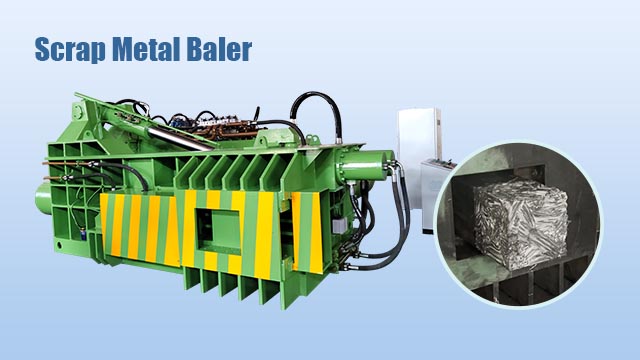
ROI shows how fast you get your money back. It is for a scrap metal baler. Many business owners use ROI to check profits. They also use it to see if costs go down. The right baler can help your business make more money.
Reports say payback takes 18 to 24 months.
Automated balers can lower labor costs by 30%. They can also make material denser by 15%.
Long-term ROI rates are often over 25%.
You should look at your numbers. You can see how Jiangsu Huanhong Hydraulic’s baler helps you get more ROI.
Key Takeaways
Knowing ROI helps you see how fast you get your money back from a scrap metal baler.
Automated balers can lower worker costs by up to 30%. They also make materials tighter by 15%. This helps you earn more money.
Check your ROI often with this formula: (Net Profit ÷ Total Investment) × 100%. This keeps you updated about your money situation.
Think about all costs, like fixing and paying for the baler, to understand how well your investment is doing.
Picking the best baler can save you a lot of money. It can also help you make more money and beat other businesses.
ROI Formula for Scrap Metal Baler
Basic ROI Equation
You need a simple formula to check how much money you make from your baler. The basic ROI equation shows your profit compared to what you spent at first. Here is the formula:
ROI = (Net Profit from Baler ÷ Total Investment in Baler) × 100%
To find net profit, you take away all costs from the money your scrap metal baler earns. These costs include buying, setting up, fixing, and running the baler. You should also think about how you pay for the baler. If you lease, get a loan, or pay cash, it changes your cash flow and your ROI.
Financial experts say you should look at a few main things when you figure out ROI. The table below lists what to include:
Key Component | Description |
Cash Flow | The money you get from the project compared to what you spend. |
Financing Options | How you pay for the equipment changes the ROI calculation. |
Impact on Business Performance | Buying equipment can help you earn more or spend less. |
Opportunity Costs | Money used for equipment could be spent on other things. |
Tax Treatment | Depreciation rules affect how much you can write off on taxes. |
You should count all these parts to see your investment clearly. This helps you make smart choices and plan ahead.
Applying ROI to Scrap Metal Recycling
When you use a baler for scrap metal recycling, your business changes right away. The right baler makes bales denser, cuts labor, and gives better reports. These things help you earn more and get your money back faster.
The table below shows how baler features help your business:
Feature | Economic Impact | Advantage |
Bale Density | +30% material value | Dual-piston compression |
Auto-Strapping | 60% labor reduction | Robotic tie systems |
Data Logging | Verified ESG reporting | Cloud-connected IoT |
You can see these gains in real examples. A distributor in Singapore got $15,000 more each month in storage by shrinking space from 10㎡ to 0.8㎡ after using a baler. The SY-220H model makes 550kg PET bales that sell for over $160 per ton. Many people get their money back in just 14 months.
You should think about long-term roi too. A baler from Jiangsu Huanhong Hydraulic keeps giving value for years. This matters in the mobile scrap metal baler market, where you need machines that move easily and handle many materials. The mobile scrap metal baler market likes machines that are simple to move and set up. You can use these balers in scrap yards, demolition sites, or recycling centers.
If you pick the right baler, you spend less and earn more. You also make your business more flexible and ready for changes in scrap metal recycling.
ROI Factors in Scrap Metal Recycling
Investment and Operating Costs
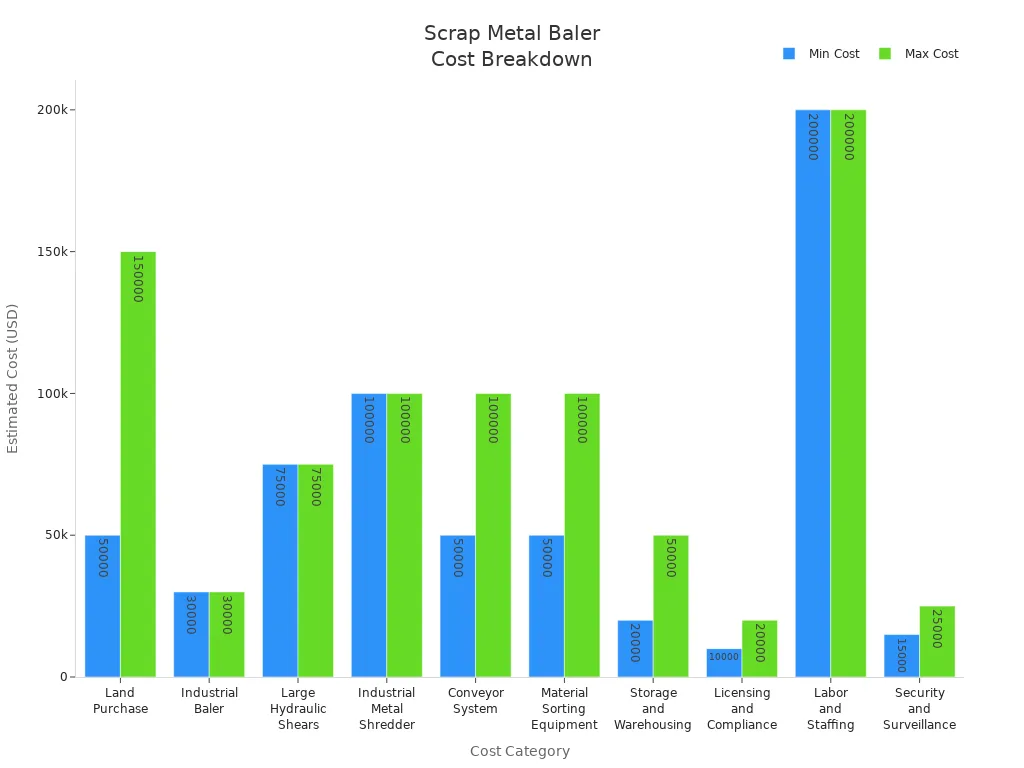
You need to know all costs before buying a scrap metal baler. These costs include the baler price, land, equipment, and labor. The table below shows common investment and operating costs:
Cost Category | Estimated Cost Range |
Land Purchase or Lease | $50,000 - $150,000 |
Industrial Baler | $30,000 |
Large Hydraulic Shears | $75,000 |
Industrial Metal Shredder | $100,000 |
Conveyor System | $50,000 - $100,000 |
Material Sorting Equipment | $50,000 - $100,000 |
Storage and Warehousing | $20,000 - $50,000 |
Licensing and Compliance | $10,000 - $20,000 |
Labor and Staffing | $200,000 annually |
Security and Surveillance | $15,000 - $25,000 |
You also need to plan for regular expenses. These include paying workers, utility bills, fixing equipment, and moving materials. Maintenance costs can be $1,000 for small balers. For big automated systems, it can be over $25,000. Picking a baler that is easy to fix can help you save money.
Labor Savings and Efficiency
A baler helps you spend less on labor and work faster. Automation in Huanhong Hydraulic balers can cut labor costs by 28%. You can get 37% more output each day. Balers shrink scrap metal by up to 90%. This makes storage and moving easier. You pay less for waste collection and lower injury risks. In the mobile scrap metal baler market, these savings are even more important. You need quick setup and simple operation.
Compaction and volume reduction
Improved material handling
Lower waste collection fees
Scrap Value and Revenue
Scrap metal value depends on type and how you process it. Baled scrap is worth more than loose scrap. Buyers like dense, neat bales. The table below shows usual market values:
Can / Metal Type | Market Value (per tonne) |
Aluminium UBC (beverage cans) | £700-1,200/tonne |
Aluminium aerosol cans (empty) | £400-700/tonne |
Steel food / drink cans | £120-200/tonne |
Mixed cans (aluminium and steel) | £200-400/tonne |
Aluminium foil (commercial) | £300-600/tonne |
A scrap metal baler can cut storage space by ten times. It also lowers shipping costs. You can load trucks faster and sell scrap for more money. This helps you earn more and get your investment back sooner.
Huanhong Hydraulic Baler Advantages
Huanhong Hydraulic balers give strong benefits to your business. Their design saves space and lets you use your workshop better. High compaction force means you can handle heavy materials and get more done. You can process many materials, which opens new markets. Full automation cuts labor costs and boosts efficiency. Safety features keep your team safe. In the mobile scrap metal baler market, these machines are easy to move and set up. Many recycling centers say they get their money back in 14 to 24 months. You can save up to 30% space and 20% on transport costs. Briquetted scrap can sell for 25% more, so you earn more.
Feature | Impact on Cost Savings and Revenue Generation |
Space-efficient design | Minimizes footprint, allowing for more efficient use of workshop space. |
High compaction force | Achieves high tonnage, suitable for heavy materials, increasing throughput. |
Versatility | Processes a wide range of materials, enhancing market opportunities. |
Full automation | Reduces labor costs and allows for unattended operation, increasing efficiency. |
Fluid recovery | Lowers fluid costs and supports environmental compliance, enhancing brand value. |
Safety features | Protects operators, reducing liability and potential costs associated with accidents. |
Increased scrap value | Briquetted scrap can command up to 25% higher prices, boosting revenue. |
Volume reduction | An 8:1 reduction in volume lowers transportation costs, enhancing profitability. |
Tip: Picking a baler from Huanhong Hydraulic can help you get more ROI. Automation, durability, and versatility matter. This is important if you want to stay ahead in the mobile scrap metal baler market.
ROI Calculation Steps
Data Collection
You need good data to figure out ROI for your scrap metal baler. Start by getting all the numbers that matter for your investment and returns. Follow these steps to make sure you have the right info:
Write down your main financial numbers. List your total investment, yearly throughput, average selling price per ton, net profit margin, and all operating costs.
Find your yearly revenue. Multiply the scrap you process each year by the average sale price per ton.
Figure out your net profit. Take your yearly revenue and subtract your total operating costs.
Work out your ROI percentage. Use this formula: (Net profit / Total investment) × 100.
See how long it takes to get your money back. Divide your total investment by your net profit to find the payback period.
You should also keep track of important numbers to make your calculations correct:
Cycle counts
Oil pressure trends
Downtime logs
Annual throughput
Uptime
Hauling savings
Maintenance costs
Payback period
ROI goes down fast if your baler stops working a lot or costs more to fix. You can stop this by doing regular maintenance and picking a reliable machine like those from Jiangsu Huanhong Hydraulic.
Modern balers, especially in the mobile scrap metal baler market, often have smart monitoring and automation. These features help you collect data by themselves and make your long-term roi better.
Example Calculation
Let’s look at a sample ROI calculation for a recycling center using a baler from Jiangsu Huanhong Hydraulic. This example uses common numbers from the industry.
Item | Value |
Total Investment | $80,000 |
Annual Throughput | 1,200 tons |
Average Sale Price per Ton | $200 |
Annual Revenue | $240,000 |
Operating Costs (annual) | $160,000 |
Net Profit (annual) | $80,000 |
Step-by-step calculation:
Annual Revenue:
1,200 tons times $200 per ton equals $240,000
Net Profit:
$240,000 minus $160,000 equals $80,000
ROI Percentage:
$80,000 divided by $80,000 times 100 equals 100%
Payback Period:
$80,000 divided by $80,000 equals 1 year
This means you get your money back in one year. If you use a baler with automation and energy-saving hydraulics, you can earn more and get your money back even faster. In the mobile scrap metal baler market, quick setup and high uptime make these numbers even better.
Adjusting for Variables
Every recycling business has different problems. You need to change your ROI calculation to fit your own situation. Think about these things:
Market volatility: Scrap prices can change fast. Watch trends and update your numbers often.
Operational challenges: Downtime, staff problems, or broken equipment can lower your profit.
Regulatory frameworks: New rules may raise your costs or make you upgrade.
Economic modeling: Use simple models to guess how changes in volume or price affect your returns.
Risk assessment: Think about what could go wrong and how it would change your ROI.
Material flow optimization: Make your process better so you handle more scrap with less work.
Cost-benefit analysis: Compare the good things from new features, like automation or smart monitoring, with their cost.
If you use a baler from Jiangsu Huanhong Hydraulic, you get strong build, automation, and smart monitoring. These help you deal with market changes and keep your ROI high. In the mobile scrap metal baler market, being flexible and easy to move helps you handle new chances or problems.
Tip: Check your data every three months. Update your calculations if scrap prices, throughput, or costs change. This keeps your ROI correct and helps you make smarter business choices.
Variables Affecting ROI
Scrap Volume and Material Type
You need to think about how much scrap you process each month. If you process more scrap, you get your money back faster. Big companies can pay off their baler sooner. For example, if you process 300 tons of scrap each month, you can make $15,000 more every month. This means you could earn $180,000 more in a year. If your baler costs $300,000, you could pay it off in about 20 months.
Monthly Scrap Volume | Revenue Increase per Ton | Monthly Revenue Gain | Annual Gain | Baler Cost | Payback Time |
300 tons | $50 | $15,000 | $180,000 | $300,000 | ~20 months |
If you work with valuable metals like copper or stainless steel, you can get your money back even faster. Small businesses might wait longer to see profits unless baling helps them sell easier or get better prices. In the mobile scrap metal baler market, being able to handle many materials helps you grow.
Market Price Fluctuations
Scrap metal prices go up and down a lot. When prices go up, your bales are worth more and you make more money. If prices drop, it takes longer to get your money back. You should watch the market and change your plans if needed. The table below shows how much you can save and how fast you can pay off your baler in a normal year:
Metric | Value |
Baler cost | $150,000 |
Operating days/year | 250 |
Labor saved per day | $200 |
Scrap value increase/day | $150 |
Annual savings | $87,500 |
Payback period | 1.7 years |
You can protect your profits by doing a few things:
Make long-term deals to sell your scrap.
Watch future prices to see changes coming.
Make deals based on how much scrap you have.
Use data and checks to keep your scrap quality high.
These ideas help you stay strong in the mobile scrap metal baler market.
Bale Size and Processing Options
Bale size is important for saving money and making more profit. Bigger and denser bales cost less to move and are easier to sell. Buyers pay more for neat, clean bales. Picking the right baler size helps you process more scrap and use less labor.
Different balers have their own good points:
Baler Type | Cost Range | Average ROI Period | Advantages | Best For |
Vertical Baler | $5,000 – $30,000 | 3-4 years | Low cost, compact, easy to maintain | Small facilities, low to medium scrap volumes |
Horizontal Baler | $50,000 – $200,000 | 2-3 years | High capacity, automation options, efficient | Medium to large facilities, high scrap volumes |
Two-Ram Baler | $150,000 – $500,000+ | 1.5-2 years | Handles diverse materials, very high compression | Large-scale, high-volume operations |
Closed-Door Baler | $30,000 – $100,000 | 2-3 years | High bale density, robust compaction | Facilities needing dense bales, moderate volumes |
Note: Scrap that is baled the right way can sell for 10-20% more than loose scrap. Picking the best scrap metal baler helps you earn more and keeps your business strong.
You can make more money if you follow the ROI steps for your scrap metal baler. Always use your own numbers and check them often. In the mobile scrap metal baler market, quick setup and flexible machines help you do better than others. You should use tools like handheld XRF analyzers. These tools help you sort metals fast and stop expensive mistakes. For the best results, pick a baler from Huanhong Hydraulic. This gives you more value in the mobile scrap metal baler market.
Check your costs and money made each month.
Teach your team how to use new tech.
Take care of your equipment so it works well.
FAQ
How often should you recalculate ROI for your scrap metal baler?
You should check your ROI every three to six months. This helps you see changes in scrap prices or costs. It also helps you notice if your production goes up or down. Checking often keeps your choices smart and current.
What types of scrap can Huanhong Hydraulic balers process?
You can use Huanhong Hydraulic balers for many materials. These include:
Steel
Aluminum
Copper
Titanium alloys
Mixed metals
This makes it easy to handle different recycling jobs.
Does automation in a baler really improve ROI?
Yes. Automation cuts labor costs and boosts daily output. You spend less time doing work by hand. You get your money back faster. Automated features also help stop mistakes and downtime.
What is the typical payback period for a Huanhong Hydraulic baler?
Most people get their money back in 14 to 24 months. Your payback time depends on how much scrap you process. It also depends on market prices and how well you run your business.
Tip: Pick a baler with smart monitoring. This helps you watch how your baler works and find problems early. It keeps your ROI safe.


