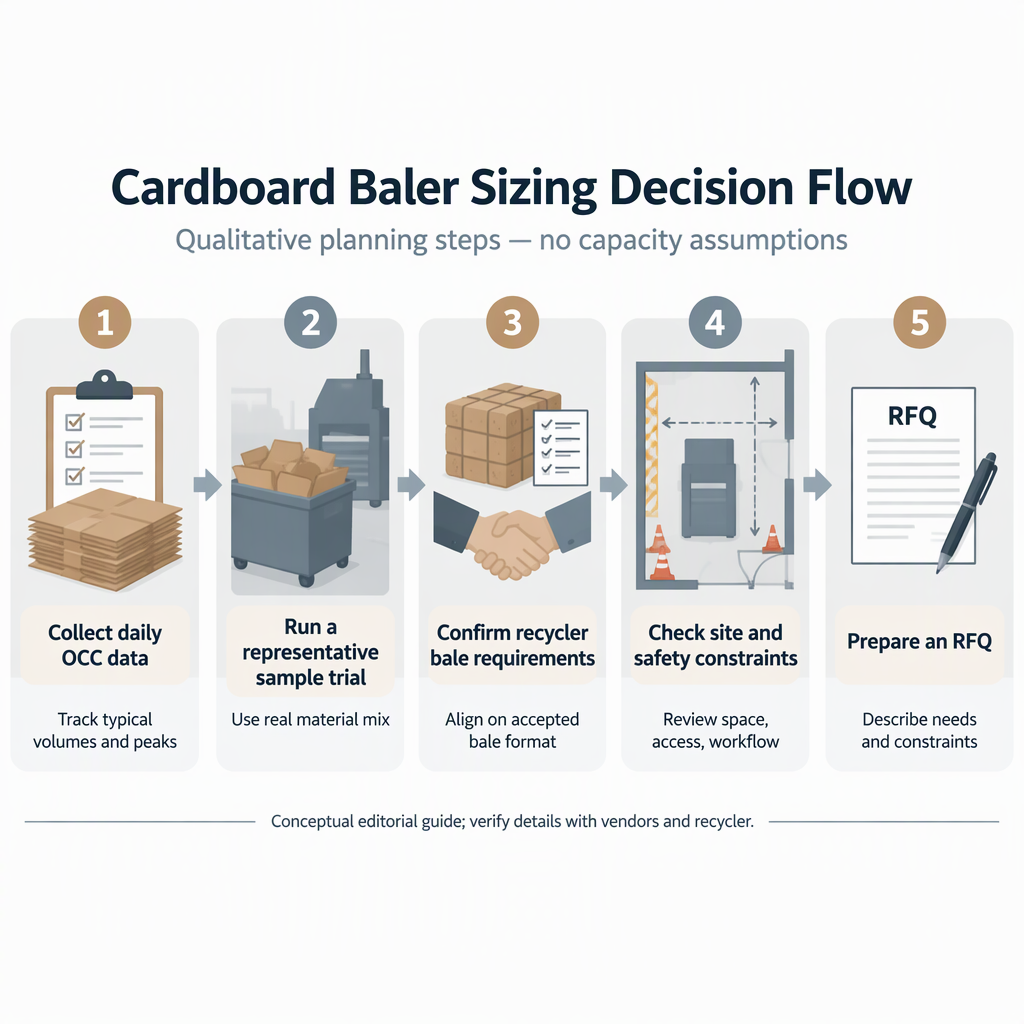
Size a cardboard baler from your real OCC flow, required bale acceptance conditions, handling space, and safety controls—not from a generic daily-tonnage label. Measure what arrives, trial a representative sample, confirm the recycler’s bale and documentation requirements, then ask suppliers to size equipment against that operating profile.
Start with the inputs that actually control baler size
The right starting point for cardboard baler sizing is a short operating profile: what cardboard grade you handle, how much arrives each day, how it arrives, how clean it is, how bales will be accepted, and what space and labor are available.
For many facilities, the material stream is old corrugated containers, or OCC. The ISRI/ReMA OCC specification page describes OCC as corrugated containers with test liner or kraft liners and also discusses limits for prohibitive materials and outthrows plus prohibitives. Use that kind of grade language to align purchasing, operations, and the recycler before you discuss machine size.
Identify the cardboard stream: OCC only, mixed paper with OCC, wet or food-contaminated cardboard, oversized cartons, edge trim, or other solid waste mixed into the stream.
Record the inbound pattern: steady hourly flow, end-of-shift cleanup, peak receiving days, seasonal surges, and whether cardboard is loose, flattened, boxed, or already compacted.
Define the outbound requirement: bale dimensions requested by the recycler, secured-bale expectations, packing-unit type, load composition, shipment quantity, and scale documentation.
Map handling resources: forklift or pallet-jack access, staging floor, operator availability, dock access, ceiling height, and the distance from generation points to the baler.
List restrictions before the RFQ: available power, noise concerns, floor loading review, fire and housekeeping controls, and the facility’s required safety procedures.
Measure daily volume and run a representative sample trial
Measure daily cardboard volume by tracking actual material for representative operating days, separating normal flow from peak flow, and comparing the trial bales with the recycler’s accepted packing and documentation requirements.
Choose a measurement window that includes normal receiving days and known peaks. If Monday returns or month-end shipments create unusual cardboard surges, capture those separately instead of averaging them away.
Separate material categories before weighing or estimating volume. Clean OCC, wet cardboard, mixed packaging, plastic film, and wood dunnage should not be treated as one homogeneous baler feed stream.
Record loose volume, handling time, and approximate mass for each shift. Use your site’s scale data where available; when scale data is not available, keep the method consistent and state the uncertainty in the RFQ.
Make sample bales from representative material and compare them with the recycler’s requested packing unit, secured-bale condition, load composition, quantity by tons, and bill-of-lading weight information.
Send the sample results to shortlisted suppliers with photos, material notes, and peak-flow information. Ask each supplier to explain the chamber size, cycle assumptions, feed method, and handling sequence used in its recommendation.
Match the machine category to the daily flow pattern
Compare baler categories by operating pattern, feed method, bale handling, site space, and recycler acceptance requirements; do not assume that a category name alone proves throughput or bale quality.
Facility condition
Selection implication
Question to ask suppliers
Low to moderate cardboard flow with batch handling
A vertical or smaller batch-oriented configuration may be considered if the labor pattern, bale handling, and recycler requirements fit.
How many daily loading cycles are expected under our measured material profile?
Steady receiving or production-side cardboard flow
A horizontal or continuous-feed approach may reduce staging pressure if the site has feeding space and material handling support.
What feed opening, conveyor, or hopper arrangement is assumed in your sizing?
Large peak surges at docks or distribution areas
Buffer staging, faster feeding, or a higher-throughput configuration may matter more than nominal bale size alone.
How does the proposal handle our peak-day material without blocking traffic?
Recycler requires specific packing units, secured bales, and load documentation
The machine and handling process must produce bales that fit the accepted packing and shipment documentation process.
Which bale format and strapping or tying method are assumed for the recycler’s requirement?
Comparison point
Vertical-style selection focus
Horizontal or higher-throughput selection focus
Best-fit operating pattern
Batch loading from sorted material streams
More continuous or higher-volume material movement
Floor-space discussion
Footprint, door swing, bale ejection, and operator access
Material feeding, monitoring, tying or ejection workflow, and forklift interface
Procurement risk
Undersizing can create piles and repeated handling
Oversizing can consume capital, floor space, and utilities without matching actual flow
Confirm bale specifications with the recycler before final sizing
Final baler sizing should wait until the recycler or mill-facing buyer confirms the accepted material grade, bale format, packing unit, contamination limits, and shipment documentation requirements.
For U.S. and Canadian OCC transactions, the ISRI/ReMA OCC specification page describes OCC grade language, limits for prohibitive materials and outthrows plus prohibitives, quantity by tons, packing-unit type, secured bales, load composition, bill-of-lading weight data, and certified-scale discrepancy handling. Treat the buyer’s current contract and local acceptance rules as the controlling commercial requirement.
This matters because a baler that looks adequate by daily volume may still be wrong if the bale is inconvenient to load, difficult to secure, rejected for contamination, or mismatched with the recycler’s scale and bill-of-lading process.
Check site fit and safety before approving the specification
A baler is not correctly sized if it cannot be fed, cleared, guarded, accessed, and maintained safely within the facility layout and the facility’s lockout/tagout and training program.
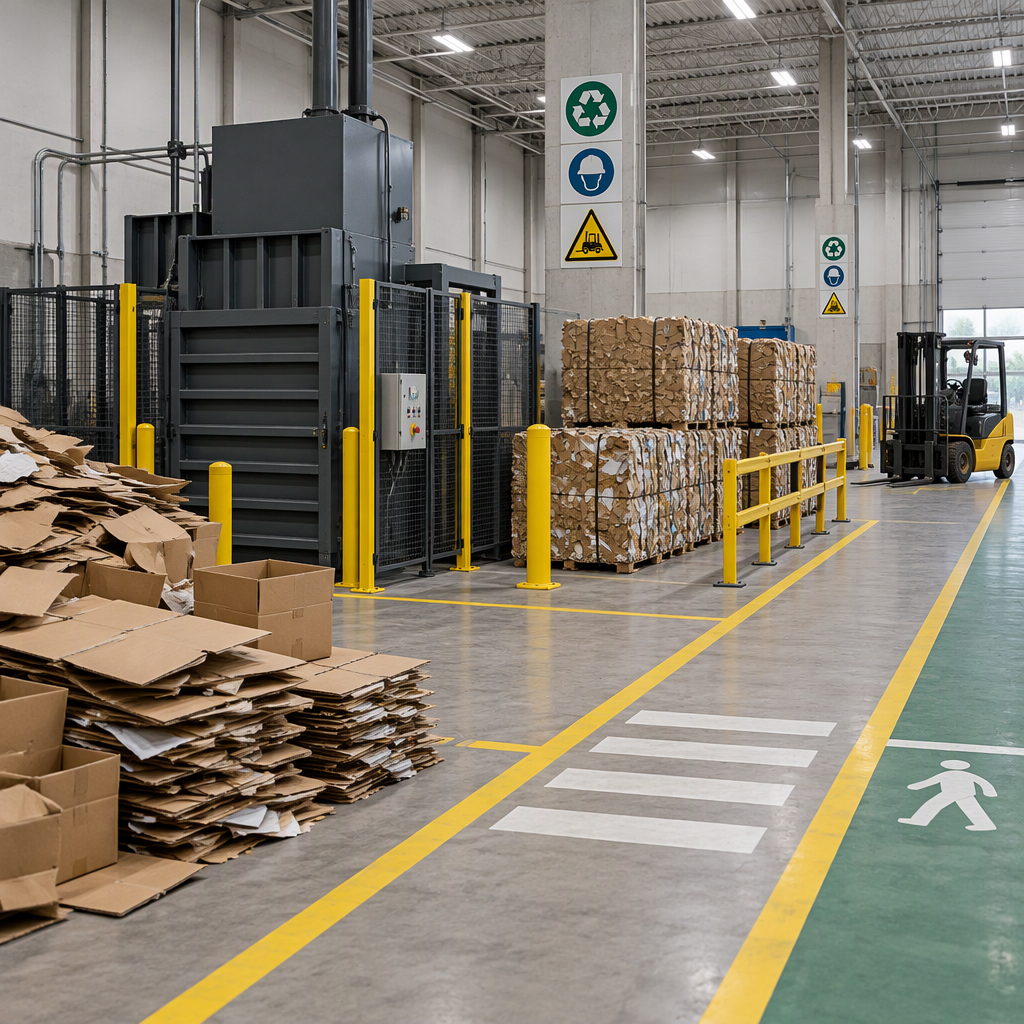
Keep the feed area out of forklift conflict zones and pedestrian routes, and leave space for bale ejection, pallet movement, staging, and emergency access.
Review guarding, safe access, procedures, training, and lockout/tagout expectations before approving the layout and operating method.
If a jam, blocked feed area, or ram-area access requires manual intervention, operators must switch off and disconnect the applicable power source before manual access, then follow the site lockout/tagout procedure and the manufacturer’s permitted access instructions.
Confirm who is allowed to operate the equipment, who is allowed to clear problems, and how supervisors verify training before the machine is placed in service.
Ask suppliers to identify routine inspection points and access clearances, but do not accept any proposal that requires bypassing guards or reaching into powered equipment.
NIOSH describes baling and compacting machines as equipment that compresses cardboard, scrap metal, and other solid waste into smaller bales. That broad hazard framing is relevant to recycling plants, metalworking plants, warehouses, and other facilities that generate cardboard alongside other recyclable or waste streams.
Prepare an RFQ that lets suppliers size from real operating data
A useful RFQ gives suppliers measured material data, bale acceptance requirements, site constraints, and safety expectations, then asks each supplier to explain the sizing assumptions behind its recommendation.
Material description: OCC percentage, contaminants, moisture concerns, carton sizes, flattening practice, and whether other materials may enter the stream.
Daily and peak flow: measured normal-day volume, peak-day volume, shift pattern, receiving schedule, seasonal variation, and any planned production growth.
Outbound requirements: accepted grade, bale format, packing-unit type, secured-bale expectations, load composition, quantity by tons, and bill-of-lading or scale documentation.
Site data: available footprint, ceiling height, door and dock access, forklift paths, power availability, floor condition, staging limits, and housekeeping requirements.
Safety expectations: guarding, safe access, lockout/tagout compatibility, jam-response boundaries, training support, operator restrictions, and maintenance access without bypassing protective devices.
Supplier response format: recommended machine category, sizing assumptions, feed sequence, expected operator tasks, installation needs, utility requirements, and the conditions under which the recommendation should be rechecked.
Conclusion
The safest buying rule is to size the cardboard baler around measured daily flow, recycler acceptance, bale handling, site layout, and documented safety controls—not around a universal bale-weight or throughput claim.
Measure normal and peak cardboard flow before requesting a recommendation.
Confirm OCC grade, packing, bale securing, shipment quantity, and weight-documentation expectations with the recycler.
Reject any layout or procedure that depends on manual access to powered, unisolated equipment.
FAQs about cardboard baler sizing
These questions help procurement, engineering, and operations teams turn measured cardboard flow into a practical sizing discussion with suppliers.
How many days should we measure before sizing a cardboard baler?
Measure enough days to capture normal flow and known peaks. A facility with steady production may need a shorter measurement window than a distribution site with weekly receiving spikes, but both should separate average demand from peak demand.
Can we size the baler from daily tonnage alone?
No. Daily tonnage is important, but the feed pattern, loose volume, carton size, labor availability, bale handling method, recycler acceptance, and site layout can change the correct machine category.
Why does the recycler’s bale requirement matter?
Recycler requirements affect the acceptable grade, packing-unit type, secured-bale condition, load composition, shipment quantity, and weight documentation, so those requirements should be confirmed before final equipment selection.
Should we buy extra capacity for future growth?
Plan for realistic growth that operations can document, but ask suppliers to show how the proposed baler performs at today’s normal flow and at the forecast condition. Oversizing can create unnecessary footprint, power, and handling burdens.
Should a sizing guide include unjamming instructions?
For a sizing decision, the better approach is to evaluate jam risk, guarding, safe access, training, and lockout/tagout compatibility. If manual access is ever required, switch off and disconnect the applicable power source before access, then follow the facility procedure and the manufacturer’s permitted method.
What should engineering verify before approving the layout?
Engineering should verify footprint, access clearances, bale ejection space, forklift paths, power availability, floor suitability, traffic separation, fire and housekeeping controls, and maintenance access.
What should procurement ask suppliers to explain?
Ask each supplier to explain the measured material data used, the assumed feed sequence, the machine category recommended, the bale handling method, the safety assumptions, and the operating conditions that would require a different specification.