

close
Choose Your Site
Global
Social Media


| Quantity: | |
|---|---|
Evaluating a heavy-duty gantry shear requires looking beyond the tonnage rating on its nameplate; one must consider its sustained performance under real-world operating conditions, the range of materials it can process, and its long-term operational reliability.
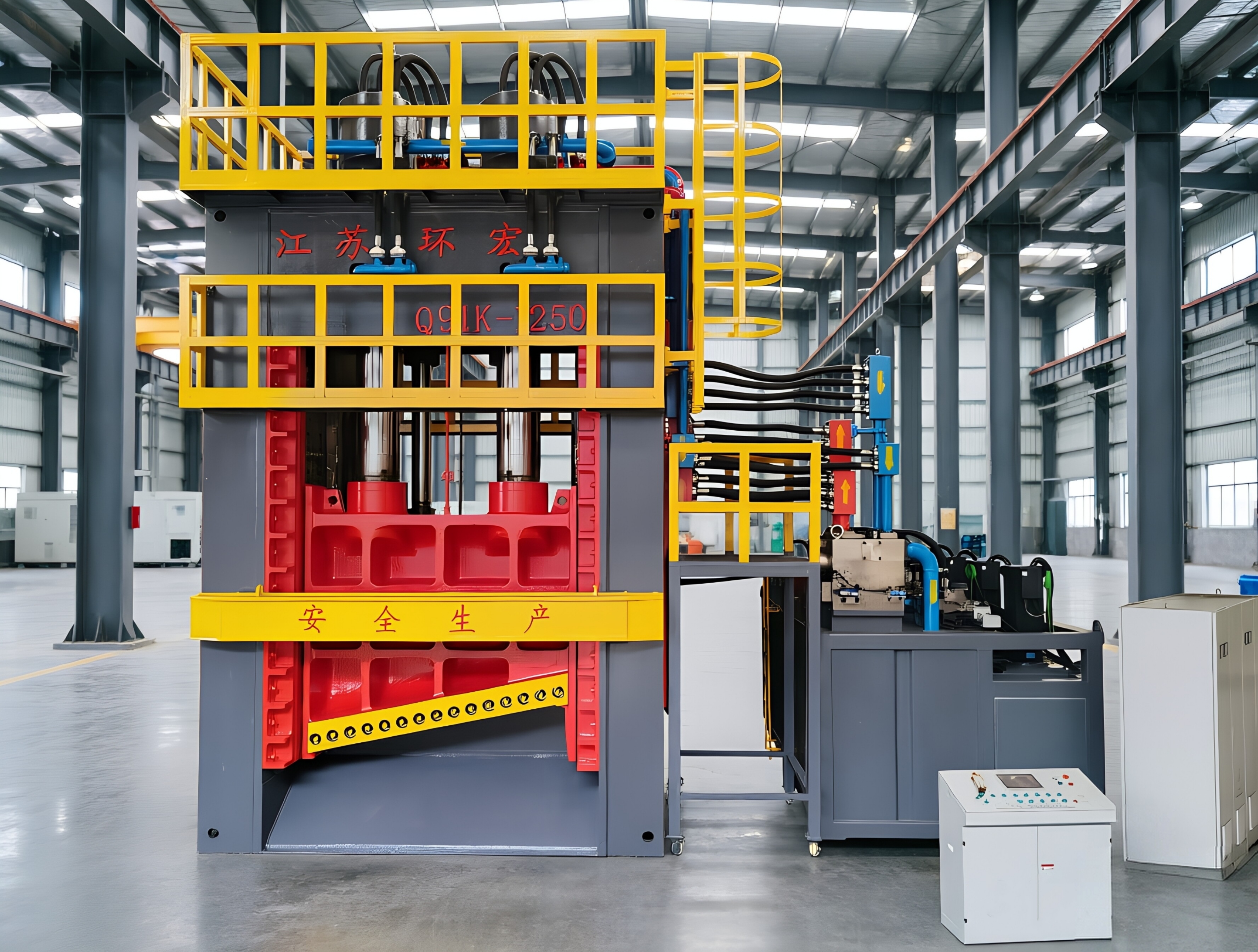
Technical specification of Q91-1250 gantry shear | |||
1 | Model | Q91-1250 | |
2 | Main cylinder | Nominal pressure | 12500 KN |
3 | Blade length | 2200 mm | |
4 | Material Bin length | 8000 mm | |
5 | Cutting times | 3~5 times/min | |
6 | Power Specifications | 380V/3P 50Hz | |
7 | Total equipment power | 90*4 KW | |
8 | Hydraulic system working pressure | ≤25MPa | |
The above parameters are for reference only. The metal shears can be customized.
1. High Shearing Force for Tough, Thick Materials.
A rated shearing force of 1,250 tons allows the equipment to effortlessly process heavy-duty scrap steel that challenges conventional shears—including thick structural steel components, decommissioned ships and vehicle wrecks, heavy machinery casings, and bundled steel rebar. The cold-shearing process requires no preheating; it cuts directly through the material, offering significantly higher efficiency than flame cutting while preventing metal loss caused by oxidation and burning.
2. Gantry-Style Compression and Shearing for Uniform Output.
The core structural advantage of a gantry shear lies in the synergy between its hold-down (compression) cylinders and the main shearing cylinder. Once material enters the feed box, the hold-down plate compresses and secures it in place before the blade carriage descends along its guide rails to perform the cut. This ensures the material remains stable throughout the process, preventing shifting or debris scattering. The resulting sheared pieces are uniform in size and possess a high bulk density, making them easier to transport and more suitable for furnace charging.
3. Hydraulic Drive: Stable and Rugged.
The machine is powered by a high-capacity hydraulic system. The shearing force automatically adjusts based on the hardness of the material, optimizing energy consumption and preventing damage to the blades caused by excessive strain. Key seals and hydraulic components are industrial-grade, designed to withstand the demanding, high-dust, and heavy-load environment of a scrap processing facility.
4. Balancing Safety and Ease of Operation.
The equipment features a centralized electrical control console, providing a clear overview of shearing cycles and system pressure. Both the blade carriage stroke and the hold-down pressure can be adjusted to suit specific material types, and operators can master the equipment and its maintenance with minimal training.
1. Raw Material Workshops in Steel Mills. Steel mills require scrap metal fed into furnaces to have a uniform size and meet specific density standards. The Q91-1250 gantry shear can process heavy incoming scrap directly to the required length, reducing the need for secondary handling and improving the efficiency of charging basic oxygen furnaces (BOFs) or electric arc furnaces (EAFs).
2. Metal Recycling and Processing Facilities. Recycling enterprises often handle a diverse range of materials with irregular shapes—such as end-of-life vehicles, appliance frames, structural steel, and mixed pipes or profiles. With its wide opening and powerful hold-down (compression) capability, the gantry shear allows these materials to be fed and cut directly, without the need for complex pre-processing.
3. Non-Ferrous Metal Processing and Smelting Enterprises. Non-ferrous scrap—including stainless steel offcuts, aluminum alloy profiles, and copper bars or wires—can be cold-sheared into uniform specifications. This facilitates subsequent smelting and batching, while also reducing material volume and lowering storage and transportation costs.
4. Scrap Recovery Lines for Heavy Equipment Manufacturers. Thick-plate offcuts and remnants from sawing processes—generated by machinery manufacturers or structural steel fabricators—can be sheared on-site and returned directly to the furnace, enabling a closed-loop material utilization process.


