Match the procedure to the individual machine: its own isolating devices, its own stored-energy points, its own layout.
Cover stored energy as well as the supply. A locked valve stops new hydraulic pressure; it does not empty the pressure already inside the system.
Keep lock and tag work with trained, authorised employees, and record that training.
Verify that the machine is isolated and de-energised before work starts, on every job however short.
Keep the file alive with periodic inspection, updated procedures and current records.
A written energy-control procedure for a baler has to state, at minimum:
How the procedure is to be used, and which machine it covers.
The steps for shutting down, isolating, blocking and securing the machine.
The steps for placing, removing and transferring locks and tags, and which employee does each.
The device used to isolate each energy source, and where that device is located.
How the effectiveness of the isolation is tested and verified before work begins.
Job length is not the test. Servicing or maintenance on a machine where an unexpected start-up or the release of stored energy could injure someone belongs inside the energy-control procedure, and a two-minute unjamming stop on a baler is that kind of job.
Which Energy Sources a Baler Lockout Procedure Must Cover
A baler lockout procedure has to cover every form of hazardous energy the machine carries: the electrical supply and any capacitor banks, pressurised hydraulic fluid, compressed air, gravity acting on the ram, platen or raised gate, and stored spring energy. Locking a valve stops new energy entering the machine. The procedure still has to identify each source and know its type and magnitude before isolation starts, and it still has to deal with the energy already stored inside the machine, because a locked isolating device on its own does not remove it.
Hazardous energy on a baler: how each source is isolated and what verification has to confirm
Energy source
Isolation
What verification has to confirm
Electrical supply, drive motors, controls and capacitor banks
Open and lock the machine disconnect or supply breaker
The control system is dead and any stored charge has been discharged before contact
Hydraulic pressure in cylinders, accumulators and lines
Close and lock the isolating valve at the power unit
Stored pressure has been bled down and the gauge reads zero
Compressed air in control and actuator circuits
Close and lock the air supply valve
Trapped air has been bled and the circuit reads zero pressure
Gravity acting on the ram, platen, gate or a loaded chamber
Lower the part to a rest position, or block and prop it
The blocked part cannot fall or travel when the restraint is tested
Springs and other mechanical stored energy
Restrain or block the mechanism
The mechanism cannot move under the stored force
Closing and locking a valve isolates new hydraulic or pneumatic energy; it does not remove the pressure already sitting in the circuit. The Canadian Centre for Occupational Health and Safety's guidance on lockout and tagout, which summarises CSA Z460-20, treats that as a bleed-and-verify step, adds blocking for gravity and spring energy, and points to capacitor discharge where electrical parts store a charge. Each of those points needs its own written step and its own check.
The Order of Steps in a Baler Lockout Procedure
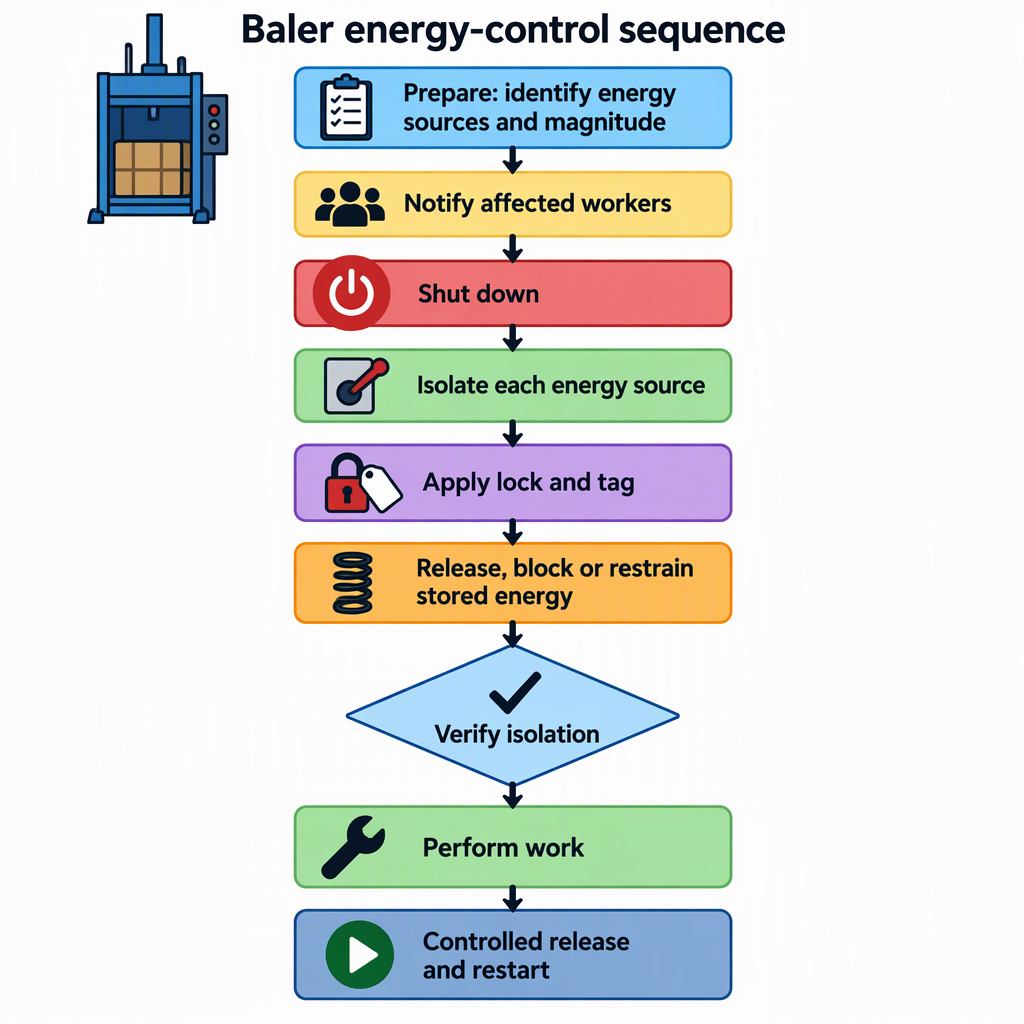
The order is fixed: notify affected workers, identify the energy sources, shut the machine down, isolate each source at its isolating device, apply locks and tags, release or block stored energy, verify the isolation holds, and only then start work. Before anyone reaches into the chamber, switch the baler off and disconnect or isolate its power source, using only the access the machine manual permits.
Tell every affected employee that the baler is going out of service and will be locked out.
Identify every energy source and its magnitude, and prepare the machine for shutdown, including a safe rest position for the ram or platen.
Shut the machine down with its normal stopping controls.
Isolate each source at its own device: the electrical disconnect, the hydraulic isolating valve, the air supply valve and any others the machine has.
Apply a lock to every isolating device, with a tag where tags are used.
Release, block or restrain stored energy: bleed hydraulic and pneumatic pressure, discharge capacitors where required, and block anything gravity or a spring could move.
Verify that the machine cannot start and that no stored energy remains at the points the procedure lists.
Isolation has to be verified before work starts on every job, however short, because verification is what proves the isolation worked. The standard requires the authorised employee to confirm de-energisation before work starts — a locked handle on its own is not proof that the machine cannot move.
Does Clearing a Jam Need Lockout Before Anyone Reaches In?
Where clearing a jam means reaching into a machine that could start unexpectedly or still holds stored energy, the work is servicing of the kind the energy-control procedure covers: switch the baler off and disconnect or isolate its power source before anyone reaches in, and use only the access the machine manual permits. If a jam cannot be cleared through that access, treat it as planned maintenance rather than improvising a way past a guard.
A 2003 agency update on baling equipment counted 34 worker deaths between 1992 and 2000 involving compacting rams and named jams and automatic restart among the recurring causes; the archived NIOSH update on baling-equipment hazards is still worth reading for how those incidents happened.
The baler-specific alert behind that campaign, NIOSH Publication 2003-124, is recorded by NIOSH as withdrawn in August 2025 and names no replacement. Treat it as historical background on how these injuries happen rather than today's rulebook, and check with NIOSH or your own regulator for the baler guidance that applies to your site now.
A guard or interlock reduces exposure during normal operation, but a guard is not an energy-isolating device, and reaching past one isolates nothing.
Who May Lock Out a Baler, and What Training Must Be Recorded
Only a trained, authorised employee may apply or remove a lock or tag on the baler, and whoever applies a lock keeps the key and removes it. Everyone else — operators, feeders, supervisors and contractors working nearby — is an affected employee: they are told before the machine is shut down and must never restart it or touch a device.
Authorised employee
Who they are: employees the employer has trained and assigned to control hazardous energy.
What they do: shut down, isolate, lock, tag, release stored energy, verify isolation, and remove their own device.
Training focus: the machine's energy sources, its isolating devices and the written procedure.
Affected employee
Who they are: operators, maintenance staff and contractors who work on or near the baler.
What they do: receive notice before shutdown, keep clear, and never restart a locked machine or remove a device.
Training focus: the purpose of the procedure and the prohibition on restarting a locked machine.
Certification of training that names each employee and records the dates of training.
Retraining notes whenever the machine, the procedure or an employee's assigned tasks change.
A current authorised-employee list for this machine, so the procedure has named owners.
Releasing Lockout and Returning a Baler to Service
Release follows the isolation sequence in reverse: inspect the machine and the area around it, confirm tools and parts are clear and everyone is out of the guarded area, remove each lock and tag only by the employee who applied it, then notify affected workers before energy is restored.
Check the machine and the space around it: guards back in place, tools, parts and debris removed, nobody inside or on the machine.
Confirm that everyone whose work touched the machine has removed their own lock; a group lockout device should be empty before it is unlocked.
Remove the locks and tags in the reverse order of application, by the employee who applied them.
Notify affected employees that the baler is going back into service before the energy is restored.
If the employee who applied a lock is not available, follow the written removal procedure: confirm that person is not at the machine, and tell them before they return to work.
Contractors, Group Work and Shift Changes on a Baler
The approach to group work is a group lockout device: the machine is isolated once, and each worker adds a personal lock to that device, so energy cannot be restored while any of them is still exposed. Contractors work to the same procedure as site employees, and the isolation stays in place across a shift change until the last person takes their lock off.
Shared work and handover: what the procedure has to set out
Situation
What the procedure has to set out
Who holds the lock
An outside contractor or service crew
How the site's procedure and the contractor's own energy-control rules are combined, and which of the site's isolating devices the contractor's locks go on.
Site control of the isolating device, with a personal lock for each contractor.
Several trades working on one baler
One group isolation point where every worker can add a personal lock, so the machine cannot be re-energised until the last lock is off.
Each worker; nobody removes another worker's lock.
Work that continues across a shift change
How the isolation and its locks carry through the handover, so the baler never goes back into service between crews.
Each worker, transferring under the documented handover.
A lock still in place when its owner has gone
The written conditions for removing another person's lock, including confirming the owner is not at the machine and telling them before they return.
The employer, following the documented removal procedure.
A group lockout device works only if every person on the job adds a lock, so write the removal procedure for the case where a lock holder is unavailable before you need it.
What to Document and How to Review the Procedure
The core records are the written procedure for this machine, the certification of training naming each employee and the dates of training, and the record of the periodic inspection the programme requires. Those three are backed by the update notes listed below, so the file also shows what has changed and why.
The written procedure for this machine, kept where the people who use it can reach it.
Training certification naming each employee and the dates of training.
A current record of the periodic inspection of the procedure, showing when it was done and what it found.
Notes of any update after a change to the machine, its isolating devices or the way it is used.
A short written review after a near-miss, an unplanned restart or a jam that would not clear, with the finding folded back into the procedure.
What to Ask the Baler Supplier Before You Write the Procedure
Ask for the machine's energy-isolation information before you write the procedure: which isolating devices the baler has and where they are, how stored hydraulic and pneumatic pressure is bled down and verified, and what the manual says about clearing jams and the access it permits. Match that to your site — how material is fed, how bales are removed, who works nearby. The supplier can describe the machine; the rules that apply at your site, and who may hold a lock, remain yours to set.
Which energy sources does this baler have, and where is each one documented?
Where is each energy-isolating device, and can every one of them take a lock?
How is stored hydraulic and pneumatic pressure bled down on this machine, and how is zero pressure verified?
What does the manual say about clearing a jam: what access does it permit, and what must stay in place?
Will the manual, parts list and any energy or utility diagram be supplied, in the language my team works in, before the machine is commissioned?
Lock ownership, the authorised-employee list, the verification method and the contractor arrangements belong in your own programme, written around the baler you have.
Conclusion
Write the procedure around the machine you actually have: list every energy source, name the isolating devices and their locations, fix the shutdown–isolate–lock–release–verify order, keep lock work with trained authorised employees, cover contractors, crews and shift changes, and record the training and periodic inspections that keep the file credible. Because lockout requirements are set jurisdiction by jurisdiction, confirm the rules that apply where the baler is installed against the official text your own regulator publishes.
The practical test: could an employee who has never worked on this baler follow the procedure, isolate every source, prove the isolation held, and hand the machine back safely? Anything the procedure needs to cover before maintenance that still depends on unwritten knowledge will eventually be skipped.
Frequently Asked Questions
These are the practical questions that come up when writing a baler lockout procedure.
How is de-energisation verified before work starts?
The authorised employee who applied the controls confirms that the machine will not start, then checks each stored-energy point the procedure lists to confirm it has been released or blocked. Writing the check into the procedure keeps it the same on every job.
Can tagout alone be used when the disconnect cannot be locked?
Tagout alone is allowed only where the machine cannot be locked out, and it carries extra obligations: additional training for the employees involved and a more demanding periodic inspection. A tag is a warning, not a physical barrier, so it is not a substitute wherever a lock will fit.
What training has to be recorded and certified?
The certification has to carry each employee's name and the dates of training. Keep it with the procedure so the file shows who was trained and when.
Does clearing a jam count as work needing lockout?
Where clearing a jam means reaching into a machine that can start unexpectedly or still holds stored energy, treat it as servicing work: switch the baler off, disconnect or isolate its power source, and use only the access the manual permits before anyone reaches in.
Is there current NIOSH guidance on baler lockout?
The baler-specific NIOSH alert, Publication 2003-124, is recorded as withdrawn in August 2025 and names no replacement, so use it as historical background on how these injuries happen rather than as today's rulebook.
Who is allowed to remove a lock?
Normally the employee who applied it: a lock is a personal control and the key stays with its owner. If that person is not available, removal by someone else has to follow a written procedure that confirms the owner is not at the machine and tells them before they return to work.
What should we ask a baler supplier before ordering?
Ask where each isolating device is, whether it accepts a lock, how hydraulic and pneumatic pressure is bled down and verified, and what the manual says about clearing jams. Ask for it in writing early enough to write and train the procedure before commissioning.
How often must the procedure be reviewed?
The programme has to include periodic inspection of the energy-control procedure, documented so the file shows when it last happened. Set the interval in your own programme, and review the procedure again whenever the machine, its devices or the way it is used changes.