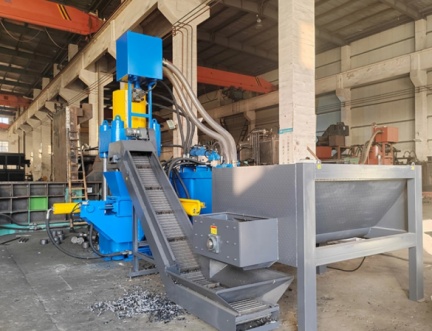
In metalworking and scrap processing, one of the most overlooked cost centers is not always the raw material itself, but the waste generated during production. Machining chips, turnings, borings, grinding sludge, and loose metal offcuts can quickly accumulate across workshops, foundries, and fabrication plants. If these materials are stored loosely, they take up valuable floor space, are harder to transport, and may deliver lower recycling value. In many cases, they also create a messier work environment and make material handling less efficient than it should be. This is exactly where a Metal Briquetting Machine becomes highly useful. Rather than treating metal scrap as loose waste, this machine compresses it into dense, manageable briquettes that are easier to handle, store, and recycle.
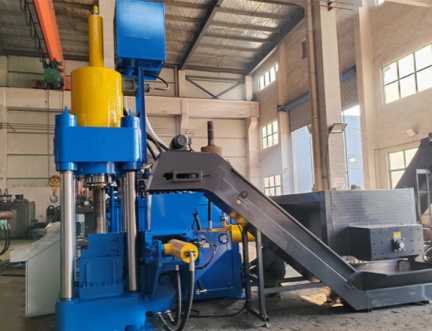
From our perspective as a hydraulic equipment manufacturer, a Metal Briquetting Machine is not just a waste-compacting device. It is a practical production tool that helps businesses improve scrap management, recover more value from metal residues, and keep their workshops cleaner and more organized. In many real-world applications, it is used to turn low-density metal chips into compact briquettes that are easier to sell, move, and reuse in downstream processes.
1 What Is a Metal Briquetting Machine?
A Metal Briquetting Machine is a hydraulic or mechanical machine used to compress loose metal waste into dense, compact blocks called briquettes. These briquettes are usually cylindrical, square, or other uniform shapes depending on machine design.
The machine is commonly used for metal scrap such as:
Instead of leaving this material loose in bins or containers, the machine compresses it under high pressure into a more solid form. This makes the scrap easier to manage and more practical for recycling or reuse.
In simple terms, the machine is used to turn loose metal waste into compact, transportable metal briquettes.
2 The Main Purpose of a Metal Briquetting Machine
The main purpose of a Metal Briquetting Machine is to improve the handling and value of loose metal scrap by compressing it into dense briquettes.
This serves several practical goals at once:
reducing scrap volume
improving storage efficiency
making transport easier
supporting cleaner workshop conditions
improving scrap handling safety
helping standardize scrap output for recycling
Instead of dealing with loose, irregular, and bulky waste, the operator gets a more organized and manageable material form.
That is why this machine is often seen as both a recycling tool and a production support tool. It helps businesses not only manage waste, but also improve the way waste fits into their overall workflow.
3 What Materials Is It Commonly Used For?
A Metal Briquetting Machine is most commonly used for loose metal residues that come from machining, cutting, and finishing operations.
Common material types include:
These materials are often generated by:
CNC machining
turning operations
milling
drilling
grinding
sawing
general metal processingBecause these materials are loose and often irregular in shape, they are difficult to manage efficiently unless they are compacted.
Common metal scrap forms
Scrap Form | Typical Source | Why Briquetting Helps |
Chips | machining operations | reduces loose bulk |
Turnings | lathes and CNC turning | improves handling |
Swarf | cutting and machining | supports cleaner storage |
Borings | drilling processes | compacts fine loose scrap |
Grinding residues | grinding and finishing | makes fine waste easier to collect |
This is why the machine is especially valuable in manufacturing environments where metalworking waste is generated every day.
4 Why Loose Metal Scrap Is a Problem
To understand what a Metal Briquetting Machine is used for, it helps to first understand the problems caused by loose scrap.
Loose metal chips and turnings often create several challenges:
A They take up too much space
Low-density scrap can fill bins quickly, even when the actual metal weight is not very high.
B They are harder to transport
Loose material shifts easily, is awkward to move, and often requires more container capacity.
C They create a messier work area
Chips and swarf can spread around machines, collection areas, and floors, making workshop housekeeping more difficult.
D They can complicate scrap sorting
Loose mixed scrap is often less organized, which can reduce efficiency in recycling or resale.
E They may reduce scrap value in practical handling
Compact, uniform briquettes are often easier to handle in recycling channels than loose, scattered scrap.
A briquetting machine is used to address these problems in a direct and highly practical way.
5 How a Metal Briquetting Machine Helps in Daily Operation
A Metal Briquetting Machine is valuable because it changes how scrap behaves in day-to-day production management.
A It reduces scrap volume
One of the most obvious uses is volume reduction. Loose chips are bulky, but once compressed, they occupy much less space.
This means:
fewer storage containers may be needed
scrap collection areas can stay more organized
workshop floor space is used more efficiently
B It creates a more manageable output
Instead of random loose waste, operators get consistent briquettes that are easier to stack, load, and move.
C It improves workshop cleanliness
When scrap is collected and compacted more systematically, the production area often becomes easier to maintain.
D It supports better material control
Briquetting turns scrap into a more standardized form, which can make internal handling and recycling processes easier to organize.
6 Common Uses in Metal Recycling and Material Recovery
The machine is widely used in metal recycling because it helps transform loose processing waste into a form that is easier to recover and re-enter the recycling chain.
Key uses in recycling include:
preparing metal chips for sale as scrap
making loose machining waste easier to transport
improving handling before remelting or downstream processing
reducing the space needed for scrap storage
organizing mixed workshop waste into more manageable batches
This is especially useful in facilities where scrap is not just occasional waste, but a daily output of production.
Recycling-related benefits
Use Case | Why the Machine Helps |
Scrap storage | less volume, better organization |
Internal transport | easier to move dense briquettes |
External shipping | more compact loads |
Scrap collection | cleaner and more controlled handling |
Material recovery workflow | more standardized output form |
In this way, the machine is used not only to compress scrap, but to improve the full scrap management process.
7 Industries That Commonly Use Metal Briquetting Machines
A Metal Briquetting Machine is commonly used in industries where large amounts of metal chips or fine scrap are generated.
Common users include:
machining workshops
automotive parts manufacturers
metal fabrication plants
foundries
bearing manufacturers
aerospace component processors
industrial subcontractors
recycling facilities handling metal residues
These operations often deal with high volumes of recurring scrap, which makes briquetting a practical long-term solution rather than just an occasional convenience.
Wherever metalworking creates loose residue in repeatable quantities, a briquetting machine can usually play a useful role.
8 Why It Is Useful for Workshop Efficiency
Many buyers first think of a Metal Briquetting Machine as a waste machine, but in practice it often supports broader workshop efficiency.
It can help by:
keeping chip collection more organized
reducing clutter around machine tools
making scrap handling less labor-intensive
improving the flow from production to waste collection
reducing the number of full scrap bins in active work areas
In metalworking environments, efficiency is often affected by small handling tasks that repeat all day. A machine that simplifies one of those repeated tasks can have a noticeable operational value over time.
Final Thoughts
So, what is a Metal Briquetting Machine used for? It is used to turn loose metal chips, turnings, swarf, and other processing residues into compact briquettes that are easier to handle, store, transport, and recycle. In practical workshop and recycling use, this means better scrap organization, reduced storage volume, improved material flow, and a cleaner production environment. Rather than treating metal waste as a difficult by-product, the machine helps transform it into a more manageable and more valuable form within the overall production and recycling process.
At Jiangsu Huanhong Hydraulic Co., Ltd., we understand that efficient scrap handling is an important part of efficient production. A well-designed Metal Briquetting Machine can make a meaningful difference in daily workshop management, recycling efficiency, and material recovery operations. If you are looking for practical hydraulic solutions for metal scrap processing and want to improve how your facility handles machining waste, you are welcome to learn more from Jiangsu Huanhong Hydraulic Co., Ltd.
FAQ
1) What is a metal briquetting machine mainly used for?
A Metal Briquetting Machine is mainly used to compress loose metal chips, turnings, and swarf into dense briquettes for easier storage, transport, and recycling.
2) What types of scrap can a metal briquetting machine handle?
It is commonly used for steel, cast iron, aluminum, copper, brass, stainless steel chips, and other loose metal residues from machining operations.
3) Why do workshops use a metal briquetting machine?
Workshops use it to reduce scrap volume, improve cleanliness, organize chip handling, and make metal waste easier to manage in daily production.
4) Does a metal briquetting machine help with recycling?
Yes. A Metal Briquetting Machine helps prepare loose metal scrap in a more compact and manageable form, which supports a more efficient recycling process.


